


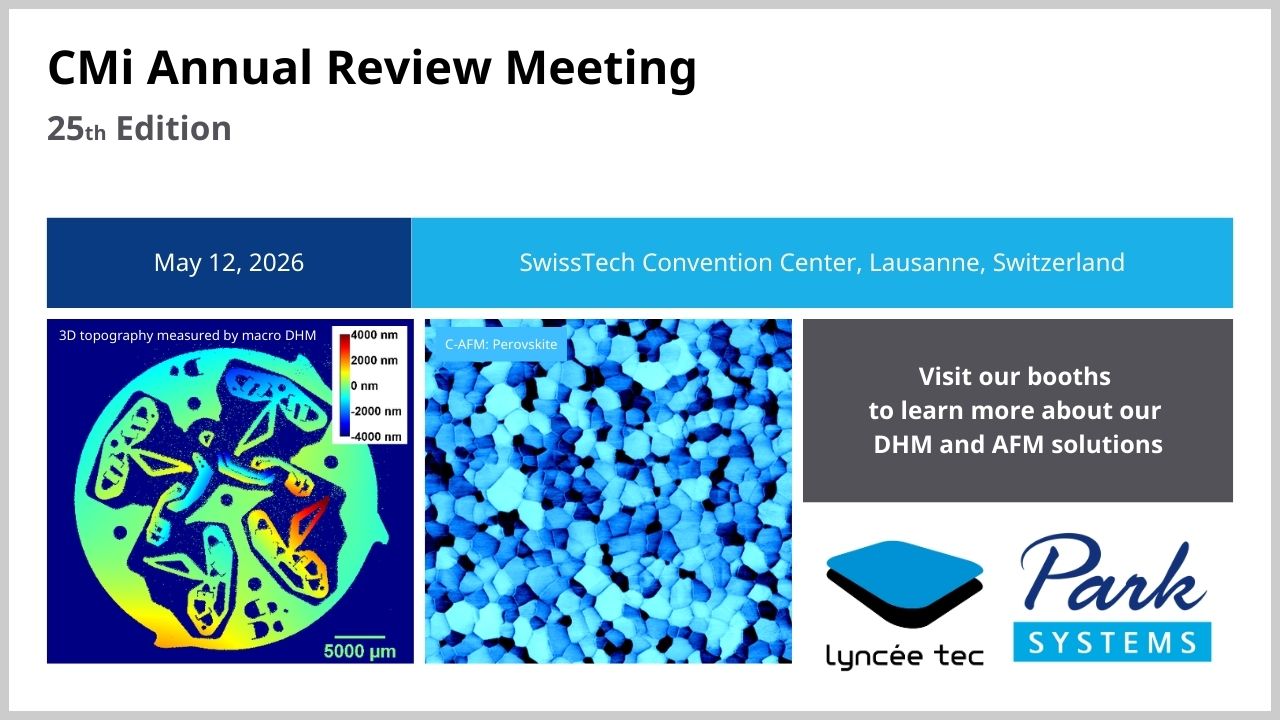
Park Systems and Lyncee Tec will participate with two separate booths in the CMi Annual Review Meeting 2026, taking place on May 12, 2026, at the SwissTech Convention Center in Lausanne, Switzerland.
The meeting brings together the CMi user community and technology partners to review recent developments in micro- and nanofabrication, characterization, and instrumentation.
- Date: May 12, 2026
- Location: SwissTech Convention Center, Lausanne, Switzerland
- Link: https://cmi-events.epfl.ch/
Park Systems — Atomic Force Microscopy
At the Park Systems booth, we will discuss atomic force microscopy solutions for nanoscale surface characterization, mechanical property mapping, and advanced AFM techniques relevant to CMi research activities.
The team will be available to exchange on:
- AFM applications in materials science and nanofabrication
- Measurement strategies for sensitive and complex samples
- Integration of AFM into research workflows
In addition to its booth presence, Park Systems will host a dedicated workshop during the CMi Annual Review Meeting 2026.
14:15 | [W3] Park Systems — Advanced Correlative Measurement Using Automated Park FX200 AFM
Room AB – Workshop
Speakers: Matthew Lefevre and Romain Bourrellier, Park Systems
Park Systems AFM solutions enable advanced nanoscale characterization of graphene on silicon carbide. By integrating KPFM, C-AFM, and sMIM on a single automated platform, users can achieve reliable, high-resolution measurements of surface potential, conductivity, and layer structure. This approach accelerates the analysis of complex 2D materials and improves productivity in research and device development.
Lyncee Tec — Digital Holographic Microscopy
At the Lyncee Tec booth, visitors can learn more about digital holographic microscopy (DHM) for label-free, quantitative phase imaging and non-invasive measurements.
Lyncee Tec will present its DHM solutions independently, reflecting its established presence in optical and interferometric microscopy.
Let’s Meet in Lausanne
We look forward to meeting CMi users and partners in Lausanne and to discussing how AFM and DHM techniques can support current and future research activities.