Lyncée T Series

What is Digital Holographic Microscopy (DHM)?

Digital Holographic Microscopy (DHM) is a patented imaging technology that reconstructs high-resolution 3D images from a single hologram without mechanical scanning. By capturing both intensity and quantitative phase information in real time, DHM enables fast, label-free, and non-invasive measurements across biological and industrial applications.

Key Benefits

  • High-resolution 3D imaging
  • No mechanical scanning
  • Quantitative phase imaging
  • Label-free observation
  • Real-time measurements
  • Digital aberration compensation

See Digital Holographic Microscopy in Action

Discover how Digital Holographic Microscopy captures quantitative 3D information from a single hologram and enables real-time, label-free imaging of living cells. This short introduction explains the measurement principle and demonstrates why DHM is uniquely suited for quantitative live-cell analysis.

In this video you'll learn

  • How DHM reconstructs 3D images from a single hologram
  • Why quantitative phase imaging is different from conventional microscopy
  • How scan-free imaging enables real-time observation
  • Why DHM is ideal for live-cell research

▶ Watch the video to understand the core principles of DHM technology.


Why Digital Holographic Microscopy for Life Science?

Digital Holographic Microscopy enables researchers to observe living cells in their natural state without labels or staining. By providing quantitative phase information in real time, DHM allows continuous monitoring of dynamic cellular processes while minimizing phototoxicity and preserving cell viability.

Key Benefits for Life Science

  • Label-free imaging — Observe living cells without fluorescent dyes or stains.
  • Live-cell monitoring — Track cellular dynamics continuously over long periods.
  • Quantitative measurements — Measure cell morphology, thickness, dry mass, and growth with high precision.
  • Non-invasive analysis — Minimize phototoxicity and maintain normal cell behavior.
  • Real-time observation — Capture fast biological events as they happen.
  • High-throughput compatibility — Ideal for drug discovery, cell biology, and automated screening workflows.
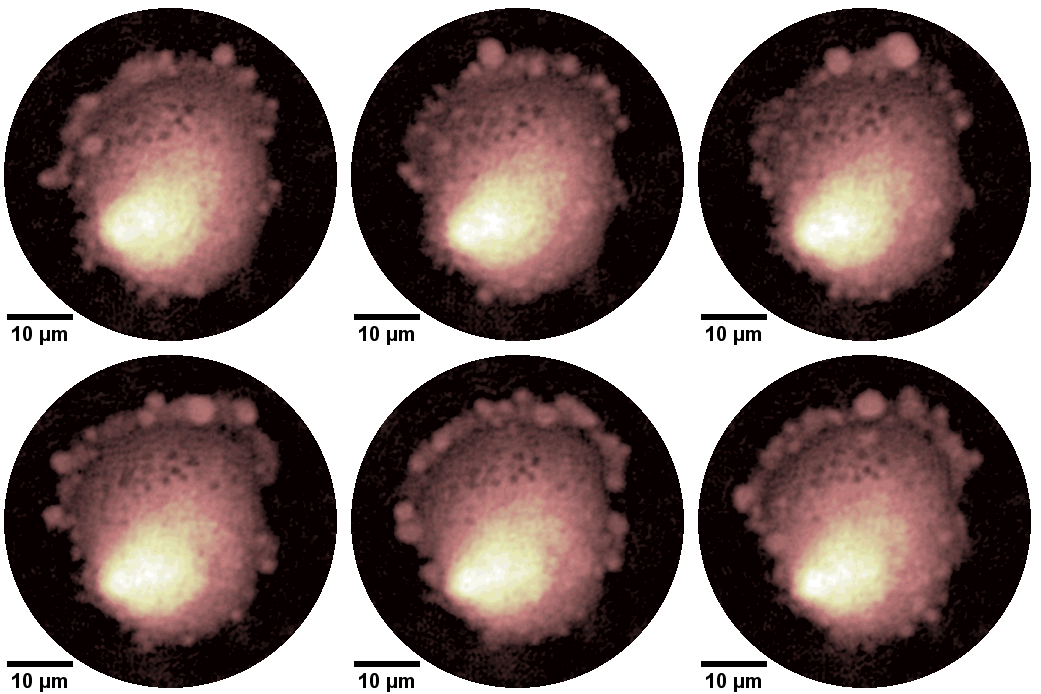
Human fibroblasts imaged with Digital Holographic Microscopy
Label-free quantitative phase image generated by Digital Holographic Microscopy

Simple Workflow for Live-Cell Imaging

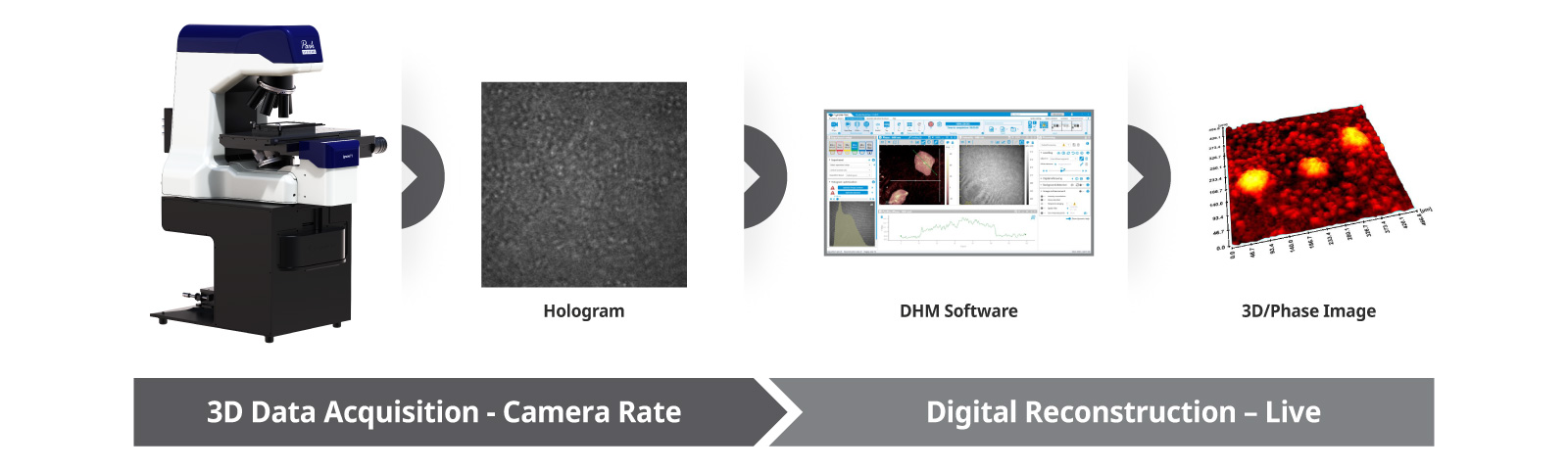
Data acquisition encodes the whole information about the sample in the recorded hologram in a single shot at camera rate speed. The recorded hologram is then numerically reconstructed in real time. Numerical reconstruction allows to refocus the phase image after the acquisition and to get quantitative information providing insights about the monitored sample.

DHM live-cell imaging workflow

Explore the Versatility of DHM Across Life Science Research

Digital Holographic Microscopy supports a wide range of life science applications, from basic cell biology to advanced cellular analysis. Among them, Cell Based Assays and Cell Viability Assessment are two of the most widely used applications, but explore all 12 to discover the full range of possibilities.

Meet Lyncée T Series

Discover the power of label-free quantitative live-cell imaging.

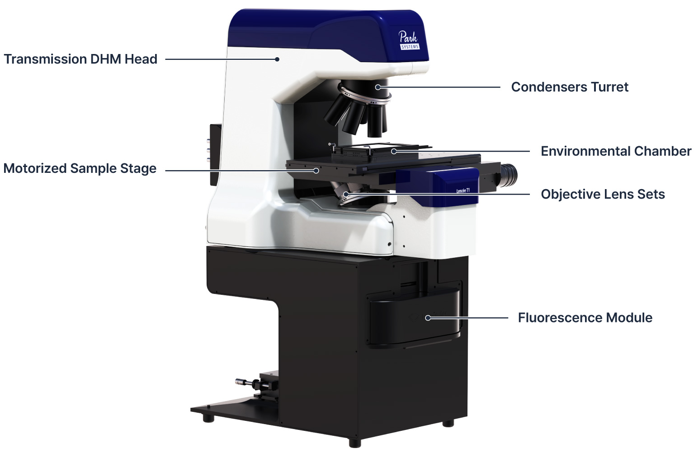
Lyncée T Series combines Digital Holographic Microscopy (DHM) with powerful analysis software to deliver real-time, label-free quantitative imaging of transparent and semi-transparent samples. By reconstructing holograms into quantitative 3D information, the system provides meaningful insights into cell morphology, dynamics, and biological processes without the need for labels or dyes.

From cell behavior and drug response to cardiomyocytes, cell viability, and long-term live-cell imaging, the T Series supports a broad range of life science applications while preserving natural cell physiology.

Lyncée T Series product

Ready to Explore Digital Holographic Microscopy for Your Research?

Discover how Digital Holographic Microscopy can accelerate your life science research with label-free, quantitative live-cell imaging. Our specialists are happy to discuss your application, recommend the right solution, and answer any questions you may have.

Prefer to speak directly with your local representative?

Contact Our Team