- Journal: ChemElectroChem
- Published Year: 2025
- Authors: Salimeh Saleh, Sven Daboss, Tom Philipp, David Schäfer, Marcus Rohnke, Christine Kranz
- Application: electrochemistry EnergyStorage, battery researchs
Summary
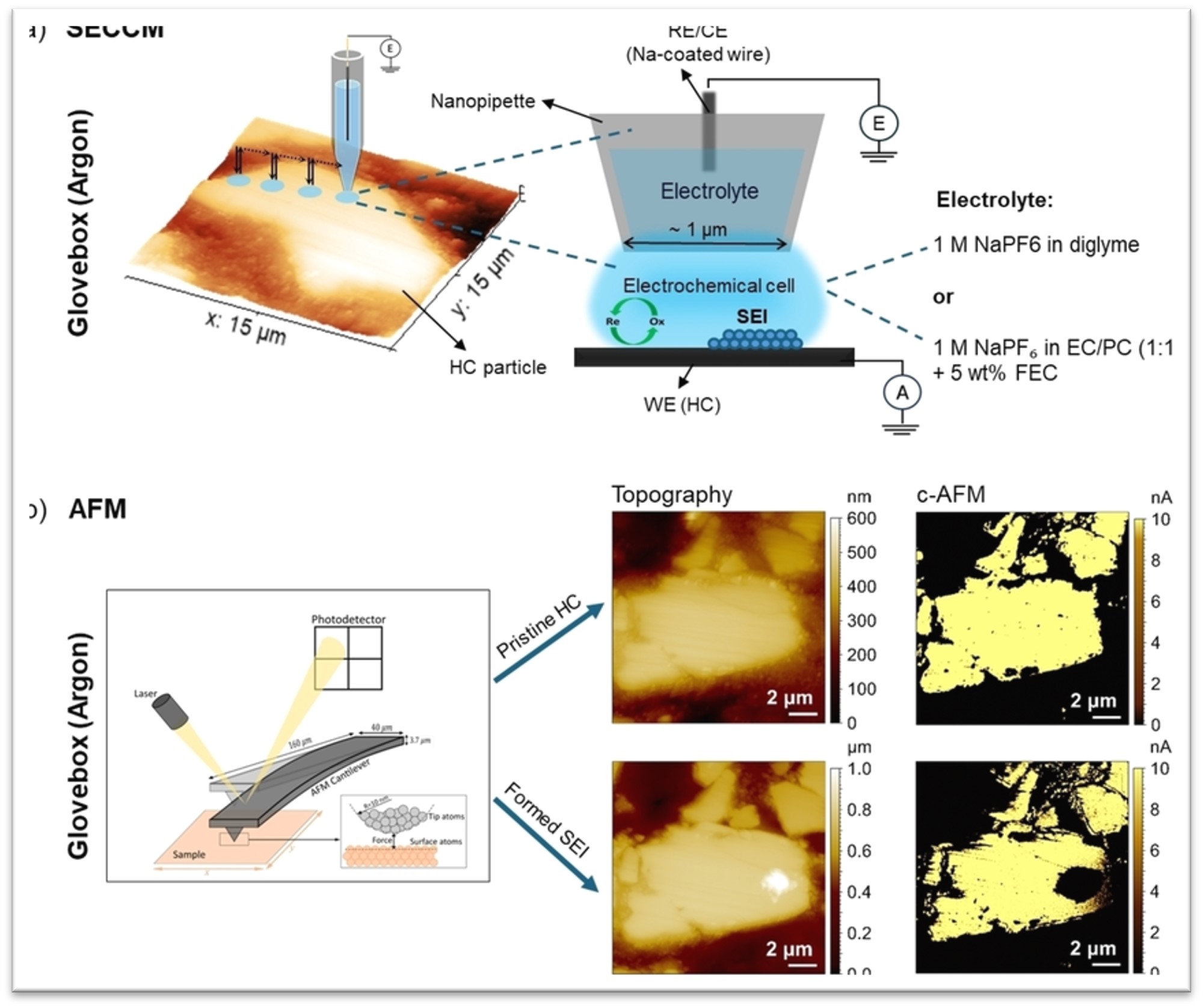
In this recent study on sodium-ion batteries, researchers from Ulm University used Scanning Electrochemical Cell Microscopy (SECCM) and Atomic Force Microscopy (AFM) to explore how solid electrolyte interphase (SEI) layers form on hard carbon anodes — a critical but still mysterious process compared to lithium-ion systems.
Using SECCM, they precisely deposited SEI microspots and then applied AFM to deeply analyze their morphology, nanomechanical properties, and passivation behavior — all on the same setup. The result? High-resolution insights into how different electrolytes and deposition conditions shape SEI properties.
This powerful SECCM–AFM combination paves the way for next-gen battery diagnostics, enabling localized, real-time analysis of interface chemistry — essential for designing more stable, efficient, and longer-lasting batteries.