Scanning Ion Conductance Microscopy-Scanning Electrochemical Microscopy
SICM-SECM
Combines SICM with SECM for simultaneous surface topography and electrochemical activity imaging
What is SICM-SECM
(Scanning Ion Conductance Microscopy-Scanning Electrochemical Microscopy)
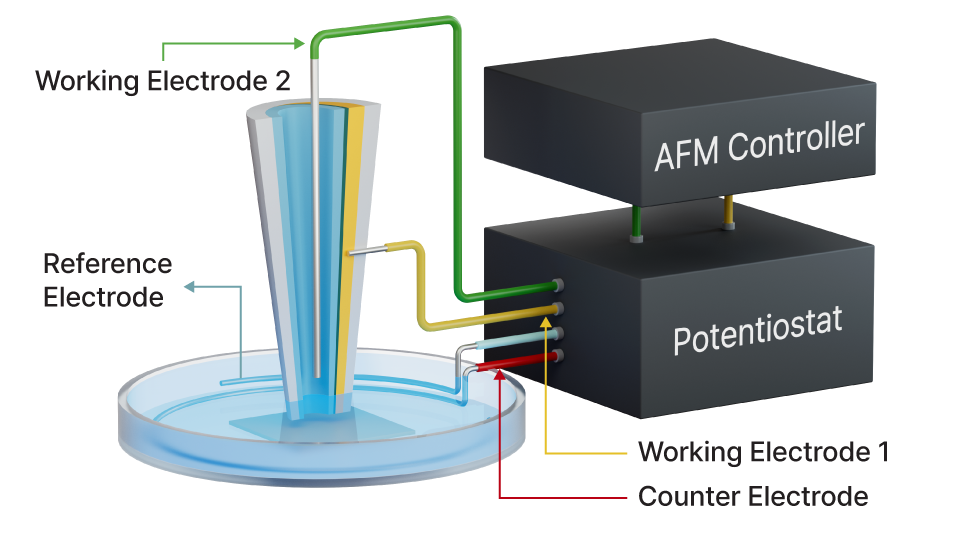
SICM-SECM measures combined surface topography and electrochemical activity by integrating ion current sensing for non-contact imaging with electrochemical detection through a multifunctional nanopipette.
Precise pipette-sample distance is maintained by SICM using ion current feedback, while SECM independently detects faradaic currents associated with surface reactivity, permitting concurrent non-contact mapping of surface morphology and electrochemical activity without cross-interference. This advanced configuration is ideal for complex materials and biological samples with heterogeneous structure and reactivity.
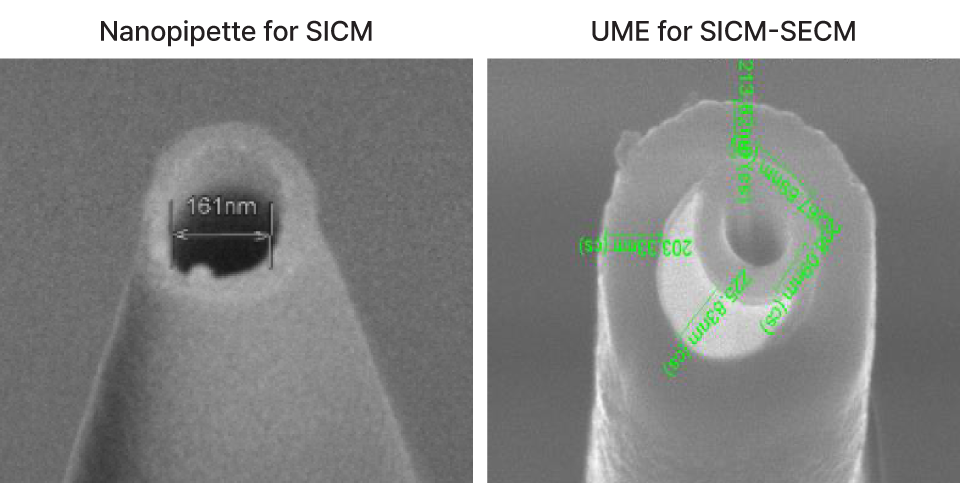
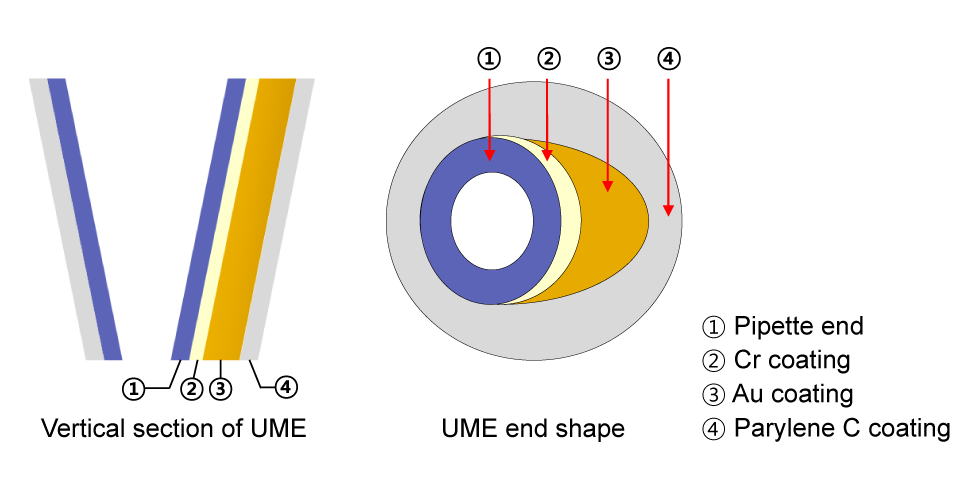
To perform simultaneous measurement of both topography and electrochemical response, a specially designed nanopipette is required, called ultramicroelectrode (UME). An UME consists of a central conductive core (Au), embedded within an insulating matrix which exposes a nano scale active surface at the tip. This configuration significantly reduces double-layer capacitance and iR drop, enhances radial diffusion, and enables low-noise steady-state electrochemical measurements in environments with high solution resistance.
SEM Images for Comparison
Schematic of UME
Reasons to Use This Mode
SICM operates by monitoring changes in ion current to maintain a precise distance from the sample without physical contact. SECM, on the other hand, detects faradaic currents from electrochemical reactions at the probe tip. In SICM-SECM, these principles are integrated: while the ion current ensures accurate topography tracking, an additional electrode in the pipette allows simultaneous measurement of local electrochemical signals. This dual feedback system enables correlated mapping of surface structure and electrochemical properties at nanoscale resolution simultaneously.
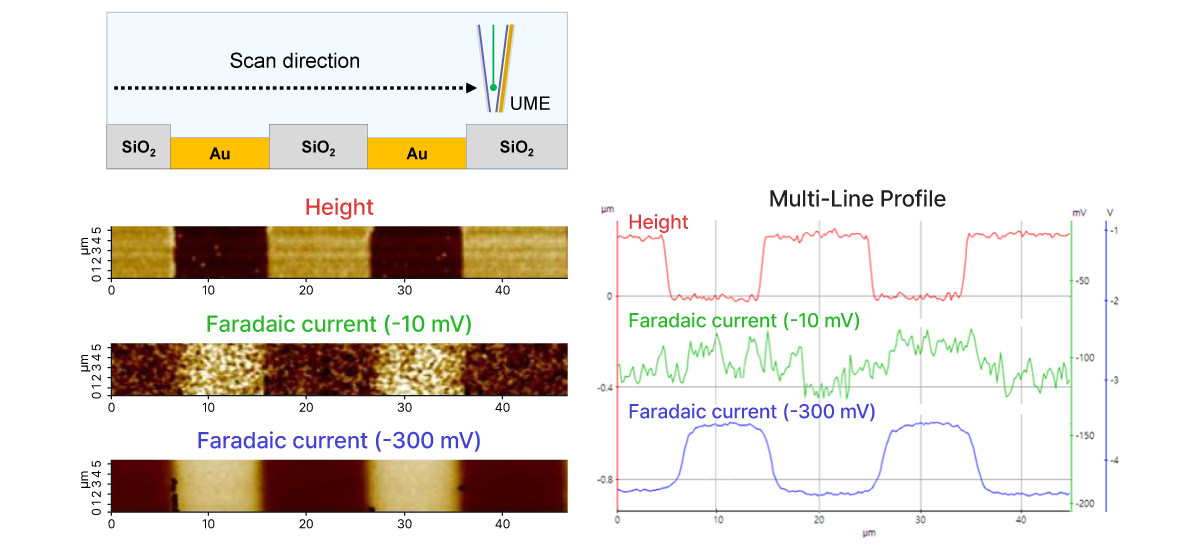
  • Sample: SiO₂-Au device
  • System: NX10
  • Scan Size: 45 µm × 5 µm
Applications and Use Cases
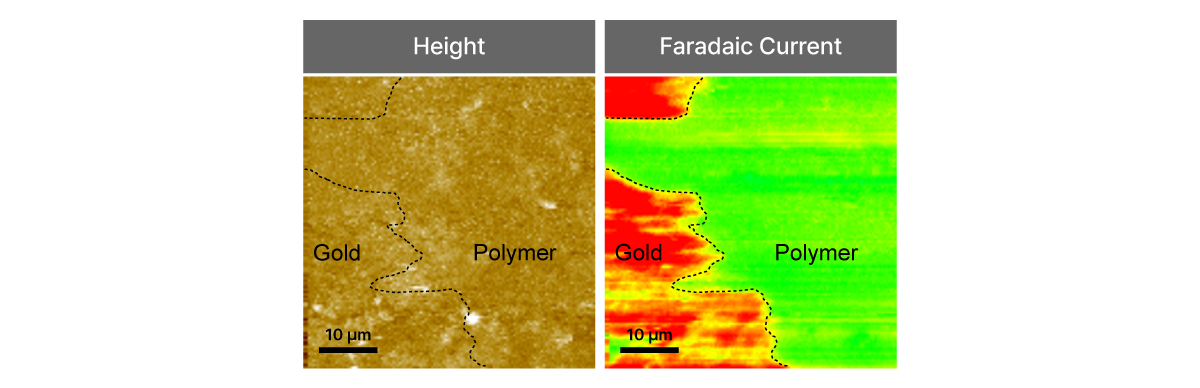
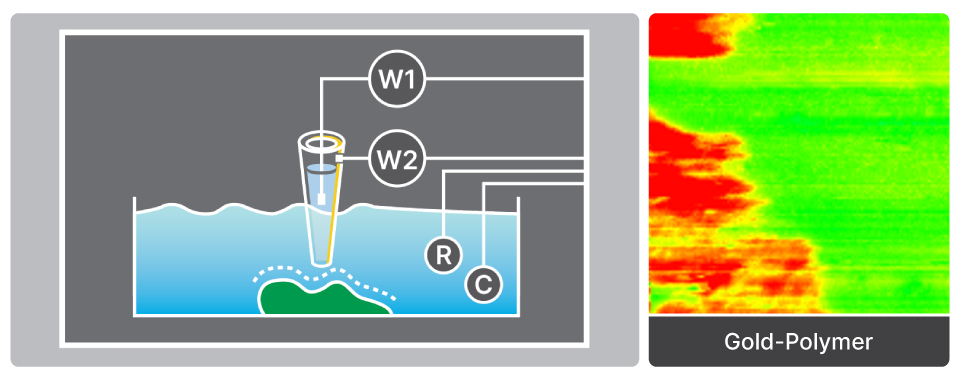
Height image by SICM signal, capturing the surface structures of the gold and polymer areas without physical contact. The other image displays the SECM faradaic current of the same region. The gold region exhibits higher local electrochemical activity (red), while the polymer region shows lower activity (green), clearly distinguishing the two materials. This combined approach highlights the strength of SICM-SECM in providing simultaneous, non-destructive topographical mapping and detailed electrochemical property analysis, enabling comprehensive characterization of complex hybrid surfaces in liquid environments.
  • Sample: Gold-polymer Sample
  • System: NX10
  • Scan Size: 50 µm × 50 µm