Photo-induced Force Microscopy
PiFM
Chemical and compositional nano-imaging by detecting photothermal-induced tip–sample forces at specific infrared absorption frequencies
What is PiFM Spectroscopy
(Photo-induced Force Microscopy)
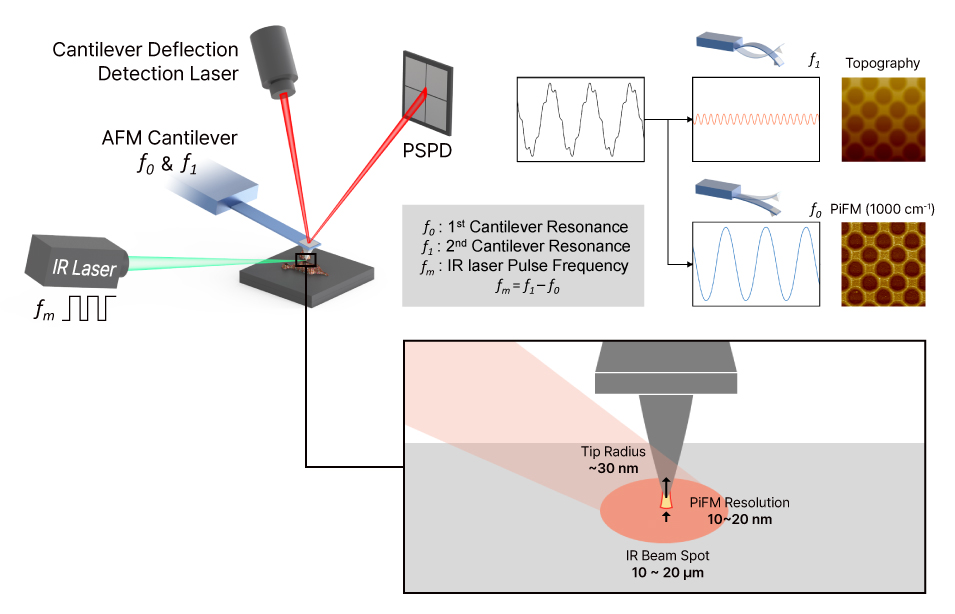
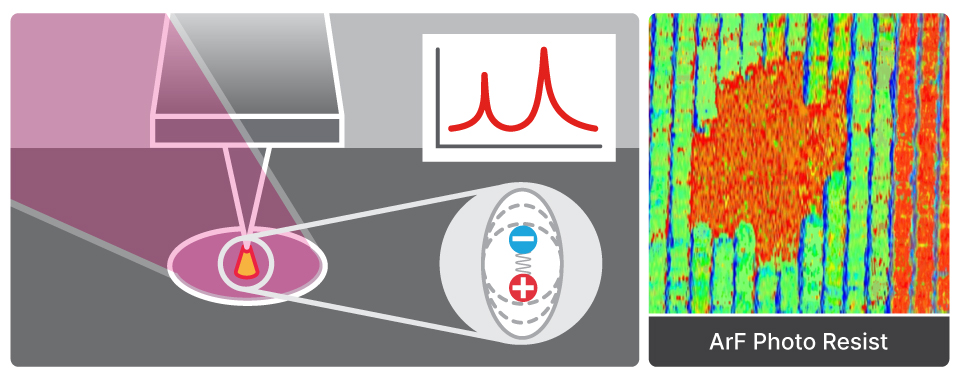
PiFM measures nanoscale topography and provides molecular-level chemical identification by detecting localized photo-induced forces generated between the AFM tip and sample under infrared laser illumination, thus combining the spatial resolution of AFM with the chemical specificity of IR spectroscopy in a single acquisition.
The laser beam travels through an internal optical path consisting of mirrors and lenses before exiting the module and being directed onto the AFM tip-sample junction via a parabolic mirror. This configuration ensures the IR laser is tightly focused on the sample interface, where photo-induced forces can be efficiently detected. The IR laser is modulated at a frequency equal to the difference between the first and second resonance frequencies of the AFM cantilever (fₘ = f₁ - f₀). The modulated IR light excites molecular vibrations at the sample surface, generating a photo-induced force that is detected through the cantilever oscillation. Despite the relatively large IR beam spot size (~10 – 20 µm), PiFM achieves nanoscale spatial resolution (~10 – 20 nm) due to the highly localized detection at the tip apex (~30 nm radius).
Reasons to Use This Mode
A key advantage of Park Systems’ PiFM is the fully automated beam alignment system. Using internal beam profilers, steering mirrors, and motorized stages, the laser is auto-aligned to the tip without manual adjustment. This automation significantly reduces user error and ensures optimal signal strength and reproducibility across measurements, making high-resolution PiFM imaging both accurate and user-friendly.

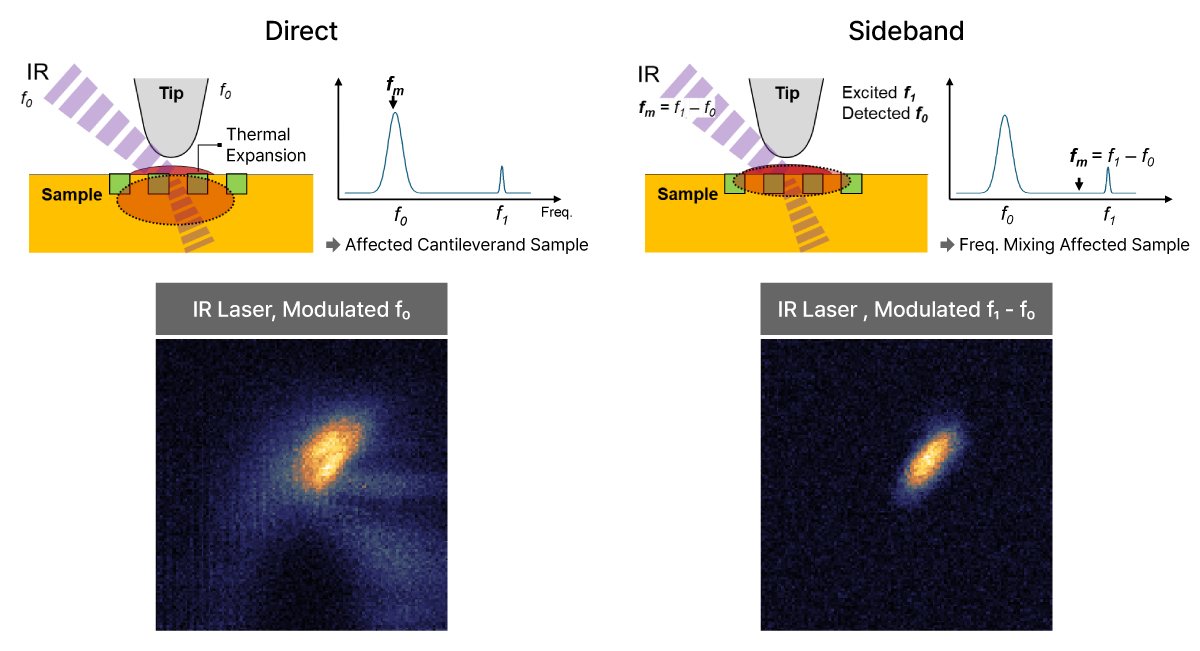
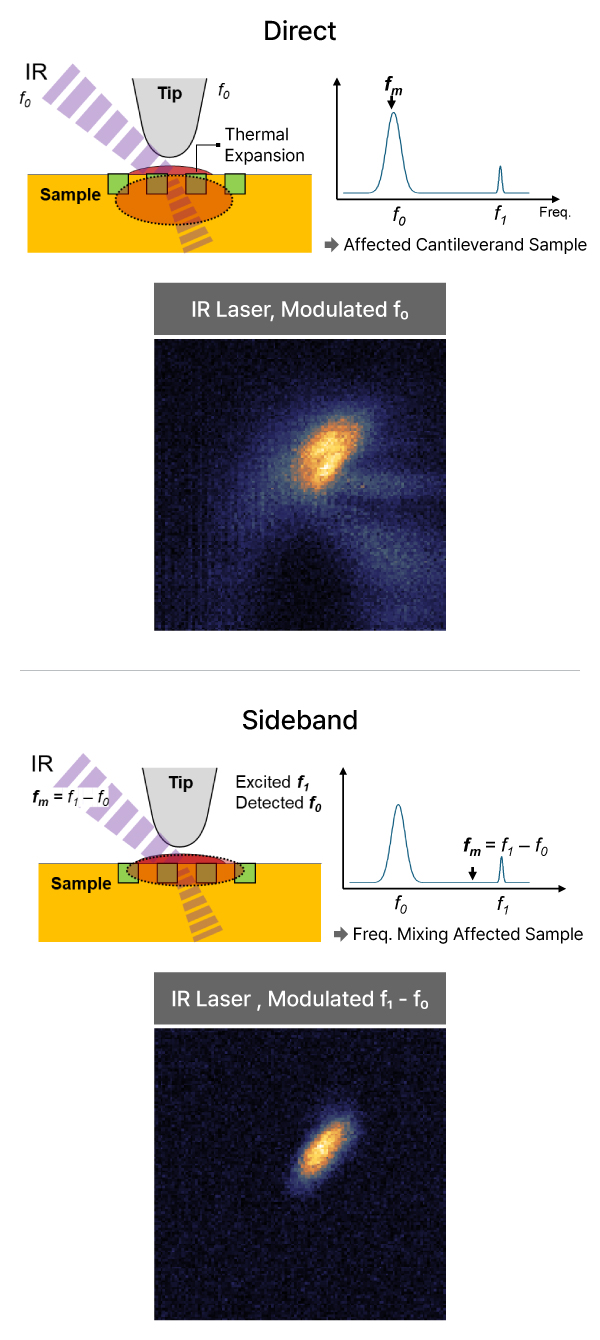
Furthermore, Park Systems’ PiFM offers two distinct detection modes, enabling researchers to optimize measurements based on sample characteristics and analysis goals. Direct mode tunes the laser to the cantilever’s resonance frequency, maximizing signal strength and making it effective for probing broader or deeper sample responses. Sideband mode modulates the laser at the difference frequency (f₁ − f₀), selectively detecting nonlinear interactions at the tip–sample interface. This allows for highly localized chemical contrast with minimal background, ideal for resolving fine features on complex or heterogeneous surfaces.
Applications and Use Cases
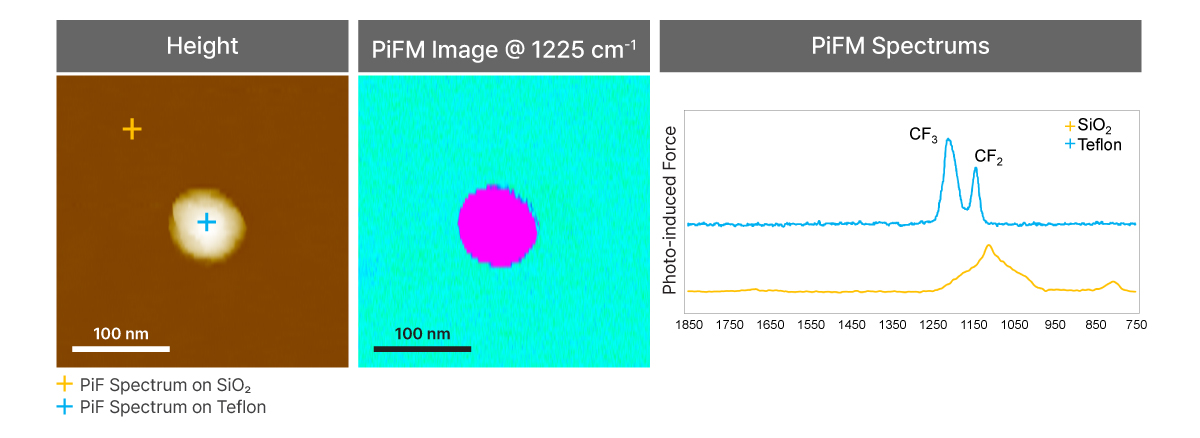
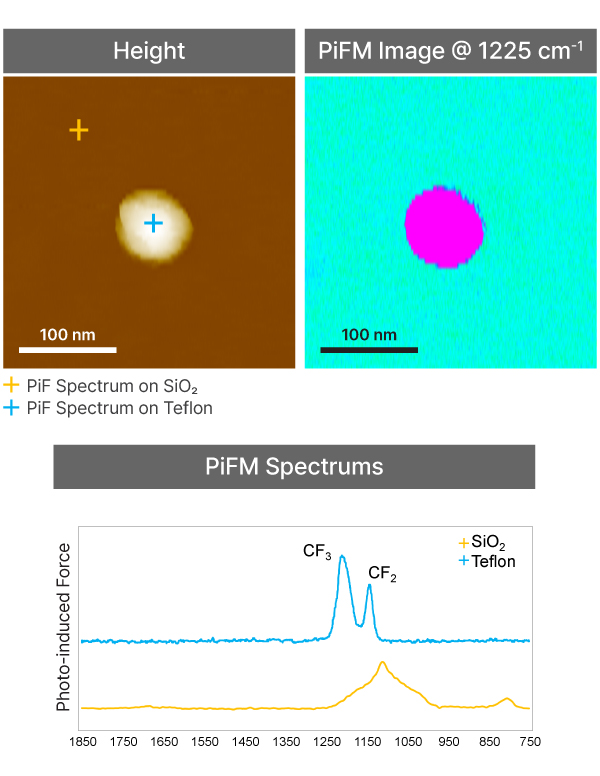
This images present a PiFM-based chemical analysis of a Teflon nanoparticle on a SiO₂ substrate. The topography (left) reveals a single round particle, while the PiF image (middle) highlights its distinct chemical contrast. Spectra acquired from the particle (blue cross) and the surrounding substrate (yellow cross) clearly distinguish the materials: the Teflon region shows strong peaks corresponding to CF₃ and CF₂ groups, which are absent in the SiO₂ spectrum.
  • Sample: Teflon Nanoparticle on a SiO₂
  • System: FX200 IR
  • Scan Size: 300 nm × 300 nm
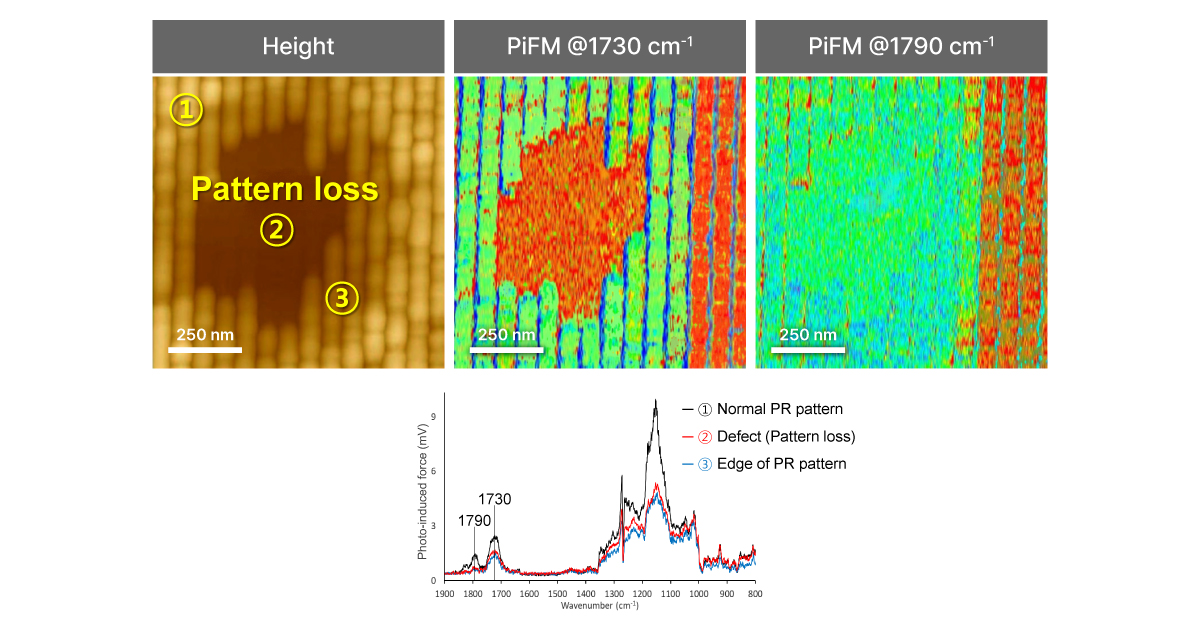
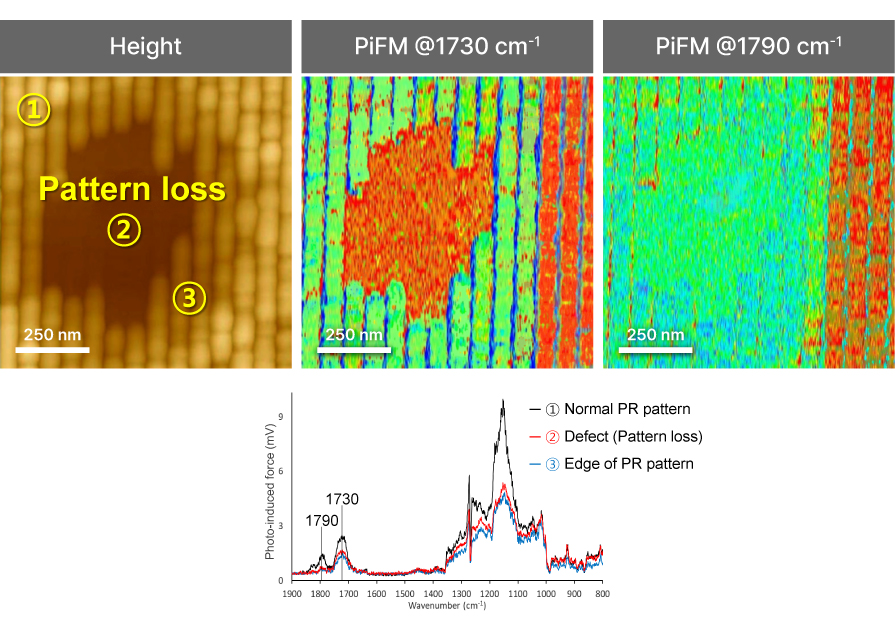
PiFM is utilized to assess e-beam-induced damage on ArF photoresist with high chemical and spatial sensitivity. Regions corresponding to ① normal PR pattern, ② defect (pattern loss), and ③ edge of PR pattern were identified and probed using PiFM. Notably, the spectrum revealed clear peaks at 1730 cm⁻¹ and 1790 cm⁻¹, both of which correlate with the presence of lactone (cyclic carboxylic ester groups) and are strongly linked to the chemical integrity and etch resistance of the ArF photoresist under e-beam and ArF laser lithography.​ By selectively mapping these wavenumbers, PiFM exposes chemical changes at the nanoscale associated with defect formation and pattern loss, enabling spatially resolved identification of molecular alterations (such as lactone depletion or byproduct accumulation) that govern etching behavior and line width control.
  • Sample: ArF Photo Resist
  • System: FX200 IR
  • Scan Size: 1 µm × 1 µm