Lateral Force Microscopy
LFM
Analyzing friction and slip behavior through mapping lateral forces across the surface
What is LFM
(Lateral Force Microscopy)
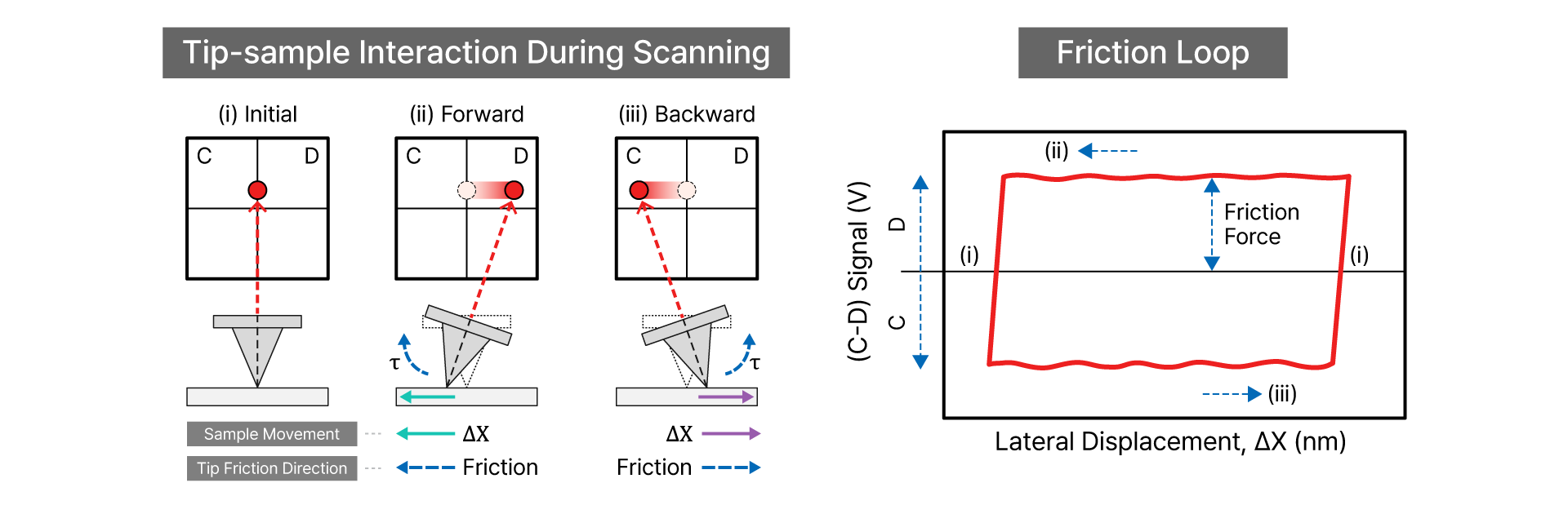
LFM measures lateral forces acting on the cantilever during scanning, enabling analysis of friction, wear, and surface texture variations.
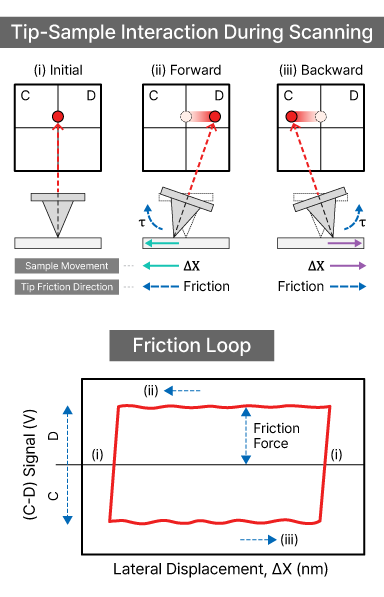
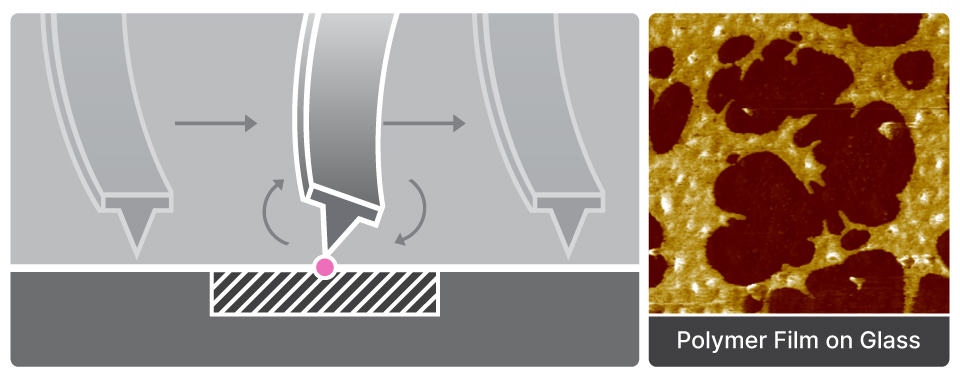
During Contact mode scanning, the AFM cantilever is subjected to both normal and lateral forces. While the vertical bending provides topographic information, the torsional twisting correlates directly to local friction. By monitoring the lateral deflection as the tip moves forward and backward over the sample, LFM generates a friction loop, visualizing variations in material composition or surface treatments.

The friction loop’s vertical width relates to friction force when calibrated. For accurate measurements, the system maintains a constant normal force (setpoint) while recording lateral signals, enabling qualitative assessment of tribological properties.
Reasons to Use This Mode
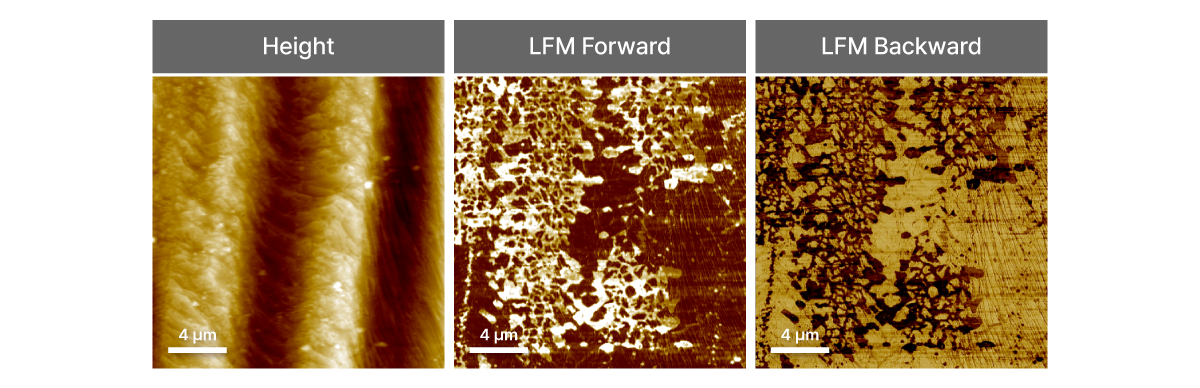
LFM provides clear, high-resolution visualization of nanoscale friction variations, enabling material differentiation (e.g., polymer blends, thin films, 2D materials) that may not be visible in topographic images alone. An exemplary LFM measurement on an inhomogeneous surface is shown in figure. The sample consists of graphene on copper. The different materials cannot be distinguished in the height image because the coated graphene is too thin to be detected on the rough copper substrate. However, LFM is ideally suited to reveal the coated graphene area on the copper substrate. The LFM forward and backward scans clearly distinguish the graphene layer from the copper substrate (the graphene-covered area appears bright in the LFM forward scan and dark in the LFM backward scan).
  • Sample: Graphene on Cu
  • System: NX10
  • Scan Size: 20 µm × 20 µm
Applications and Use Cases
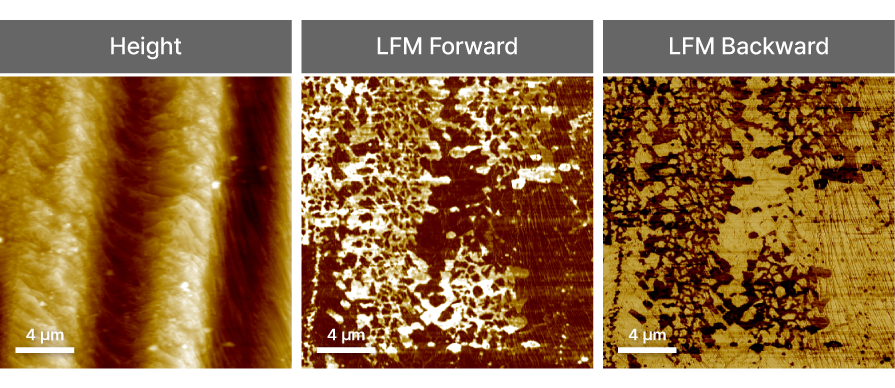
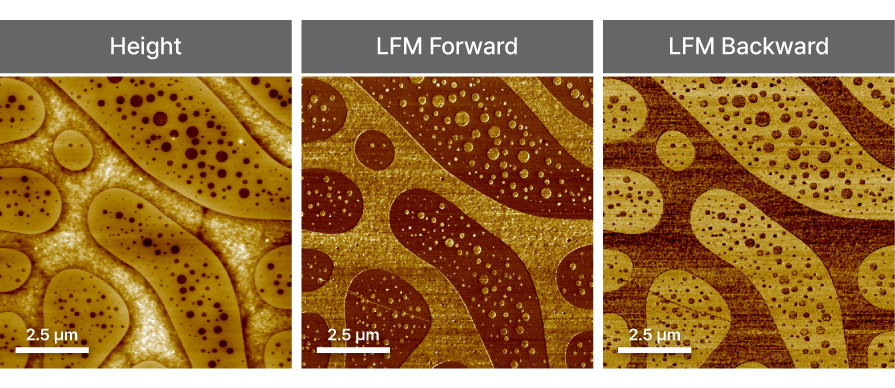
A blended PS/LDPE polymer film spin-coated on silicon is measured by LFM. While the height image reveals overall surface morphology, it does not clearly distinguish the different polymer phases. In contrast, the LFM forward and backward scans distinctly highlight the heterogeneous distribution of PS and LDPE domains based on their frictional properties. The PS and LDPE regions exhibit strong contrast, appearing bright or dark depending on scan direction. This inversion between forward and backward images confirms that the contrast arises from lateral friction differences rather than topography.
  • Sample: PS-LDPE
  • System: NX10
  • Scan Size: 10 µm × 10 µm
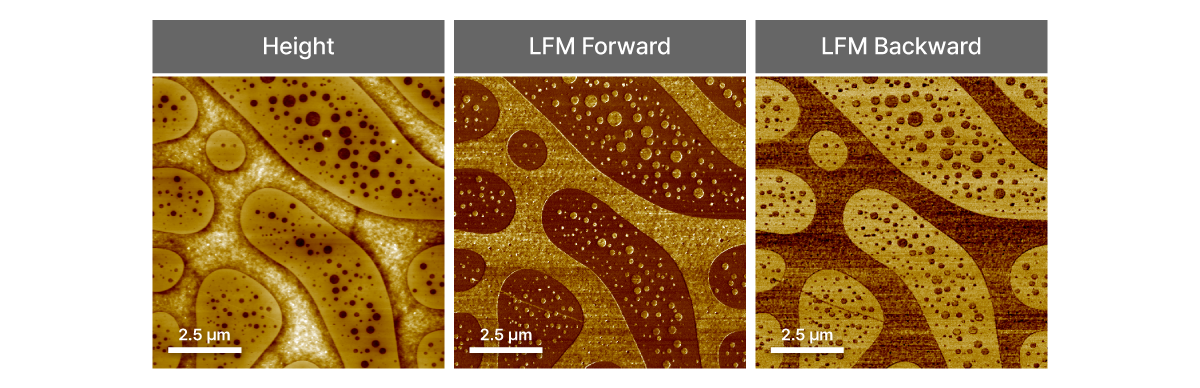
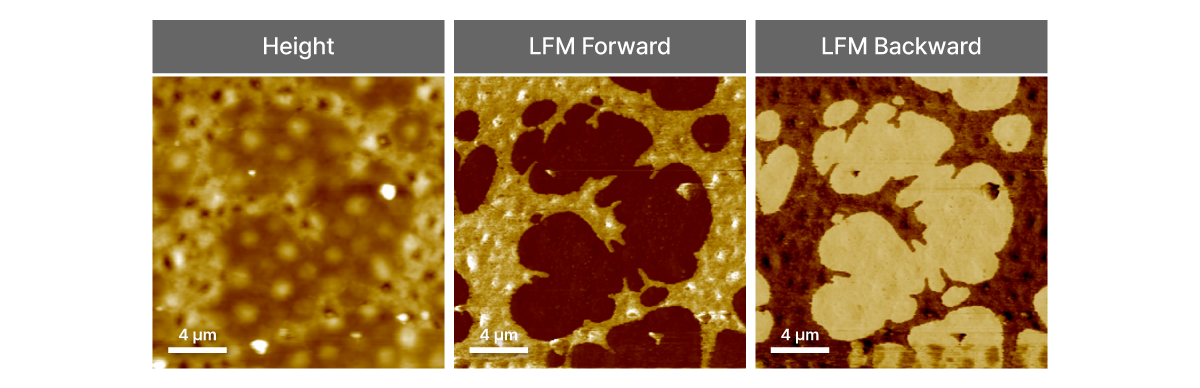
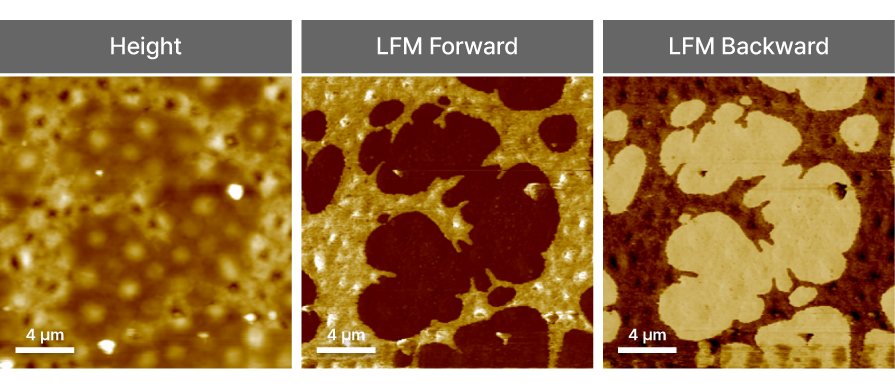
The figure showcases another application of LFM in characterizing a polymer film on glass. LFM images, acquired in both forward and backward scan directions, visualize nanoscale friction differences across the film surface, revealing domain boundaries and material heterogeneity that are not evident in topography alone. This approach enables precise mapping of tribological properties, supporting the analysis of composite materials and surface treatments.
  • Sample: Polymer Film on Glass
  • System: NX7
  • Scan Size: 20 µm × 20 µm