Sideband Kelvin Probe Force Microscopy
Sideband KPFM
Enhanced surface potential sensitivity and spatial resolution through resonance frequency detection
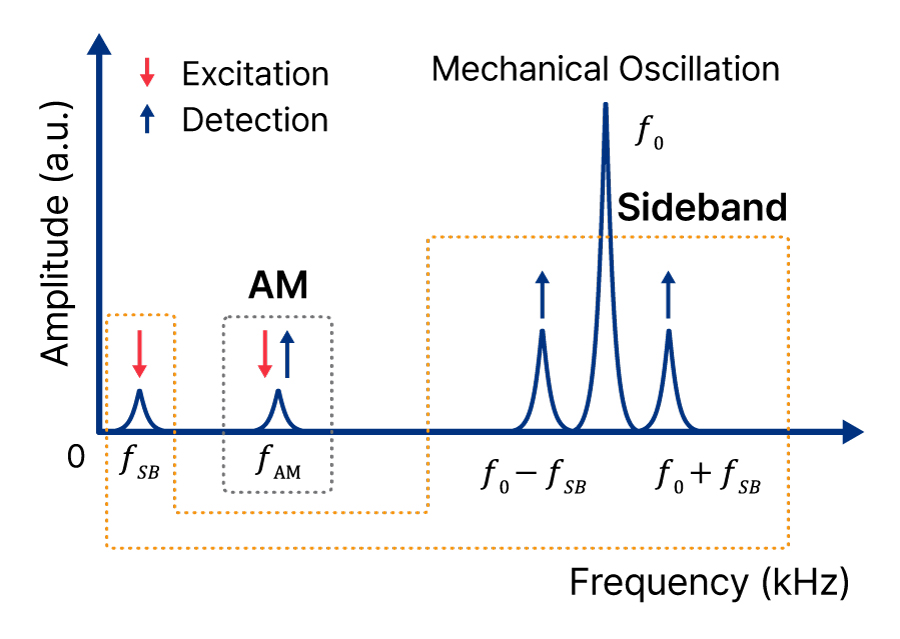
What is Sideband KPFM (Sideband Kelvin Probe Force Microscopy)
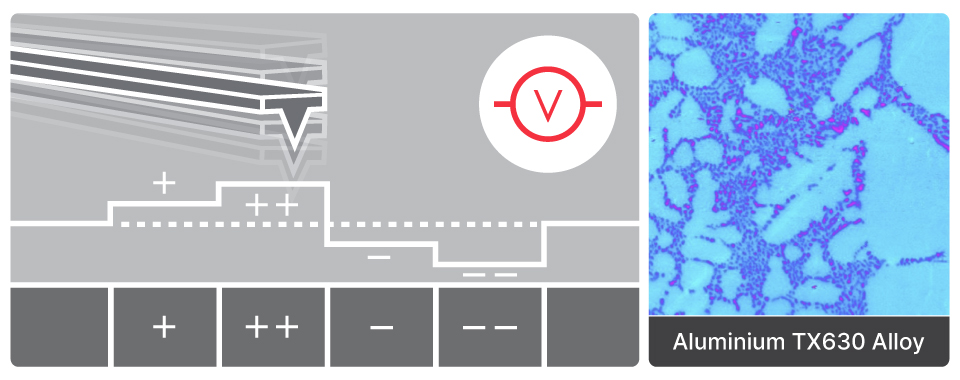
Sideband KPFM measures surface potential and work function by detecting electrostatic force gradients at sideband frequencies, enabling quantitative nanoscale mapping of electronic properties with enhanced sensitivity and spatial resolution.
In Sideband KPFM, an AC voltage is applied at a low frequency 𝑓SB, which excites electrostatic force modulation between the tip and sample. This low-frequency excitation does not directly drive the cantilever resonance but modulates the electrostatic interaction.

Detection is then performed at frequencies shifted by ± 𝑓SB from the cantilever's mechanical resonance frequency 𝑓₀, creating two sideband signals at 𝑓₀ − 𝑓SB and 𝑓₀ + 𝑓SB . By monitoring these sidebands, the technique isolates the localized electrostatic force gradient acting specifically at the tip apex.

This frequency separation strategy greatly reduces contributions from long-range electrostatic forces and the cantilever body, enhancing spatial resolution and signal sensitivity. As a result, Sideband KPFM achieves more precise and high-resolution surface potential mapping compared to conventional amplitude modulation (AM)-KPFM, which detects the total force at lower frequencies.

The figure effectively visualizes how the excitation and detection frequencies are decoupled and how sideband signals are selectively used to obtain localized electrostatic information.
Reasons to Use This Mode
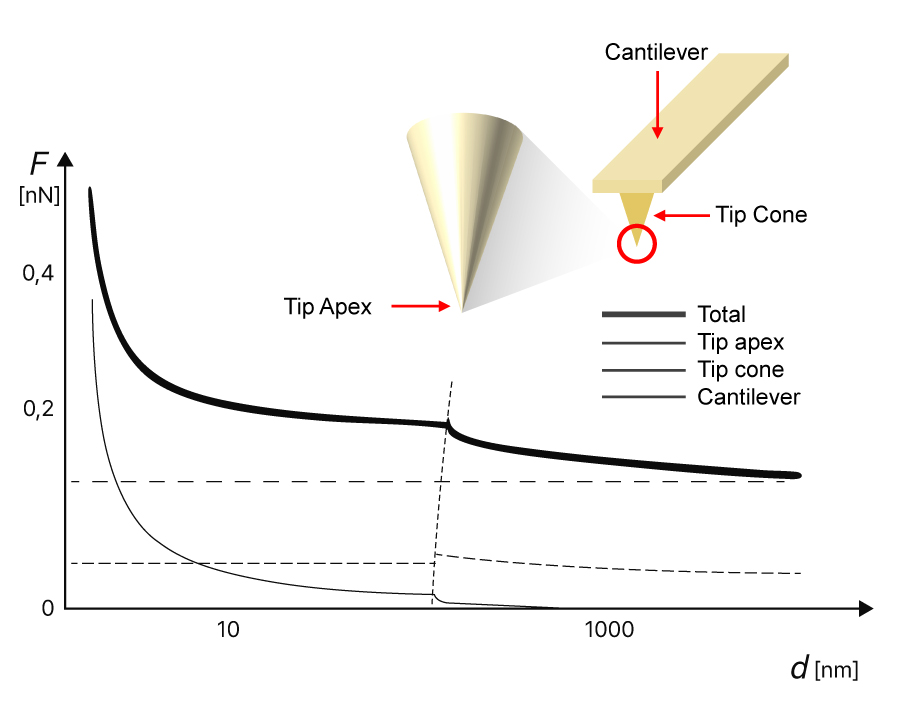
Graph and image show the principle behind enhanced spatial resolution in Sideband KPFM compared to AM-KPFM (also known as conventional KPFM).

In AM-KPFM, the tip senses the total electrostatic force, which originates not only from the tip apex but also from the larger cone and cantilever body. This results in a relatively broad interaction area and limited lateral resolution.

In contrast, Sideband KPFM detects the electrostatic force gradient at the tip apex, as shown in the enlarged schematic in the upper part of the figure. By selectively sensing the localized force gradient, Sideband KPFM effectively suppresses contributions from the cone and cantilever, drastically improving spatial resolution and enabling more precise surface potential mapping at the nanoscale.

The force-distance curves further emphasize this difference, highlighting how localized detection reduces long-range averaging effects and allows for higher fidelity in distinguishing fine surface features.
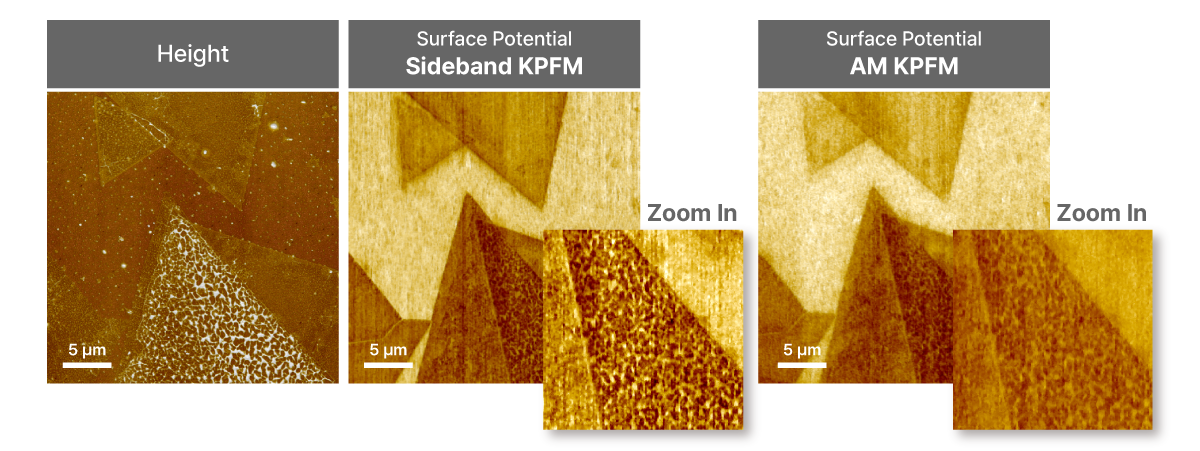
This comparison evaluates the surface potential mapping capabilities of AM-KPFM and Sideband KPFM on multilayer MoS₂ flakes. Height image resolves overall flake geometry and step heights but lacks electronic specificity. AM-KPFM detects global surface potential variations; however, its sensitivity is diminished by long-range electrostatic interactions integrated across the cantilever, resulting in limited domain boundary resolution and reduced local contrast. Conversely, Sideband KPFM leverages detection of tip-apex-localized electrostatic force gradients at the cantilever’s resonance sideband, providing superior lateral resolution and enhanced material contrast. This method effectively resolves internal potential fluctuations, fine domain structures, and subtle work function differences within MoS₂ flakes, including grain boundaries undetectable by AM-KPFM. These results underscore the advanced spatial and material sensitivity of Sideband KPFM, establishing its utility for quantitative characterization of nanoscale electronic heterogeneity in 2D materials.
  • Sample: MoS₂
  • System: NX10
  • Scan Size: 30 μm × 30 μm
Applications and Use Cases
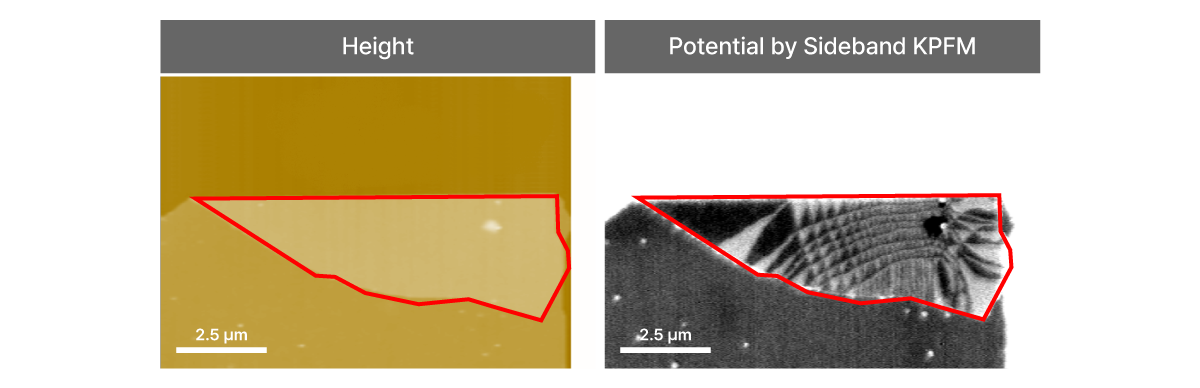
This application highlights the capabilities of Sideband KPFM for investigating nanoscale electronic phenomena in two-dimensional materials. After mechanically folding a monolayer of hexagonal boron nitride (hBN), a moiré pattern emerges within the region where the layers overlap, as indicated by the red dashed boundary in the images. While height image reveals only the geometric contour of the folded area, Sideband KPFM enables quantitative mapping of the surface potential with high spatial resolution. The technique sensitively detects local variations in the electrostatic potential of the moiré superlattice, distinguishing domains of higher and lower surface potential resulting from atomic alignment and electronic reconstruction where the sheets meet.
  • Sample: Moiré Patterns on Folded hBN
  • System: NX10
  • Scan Size: 12 μm × 8 μm