Kelvin Probe Force Microscopy
KPFM
Nanoscale imaging of surface potential and work function via electrostatic force compensation
What is KPFM (Kelvin Probe Force Microscopy)
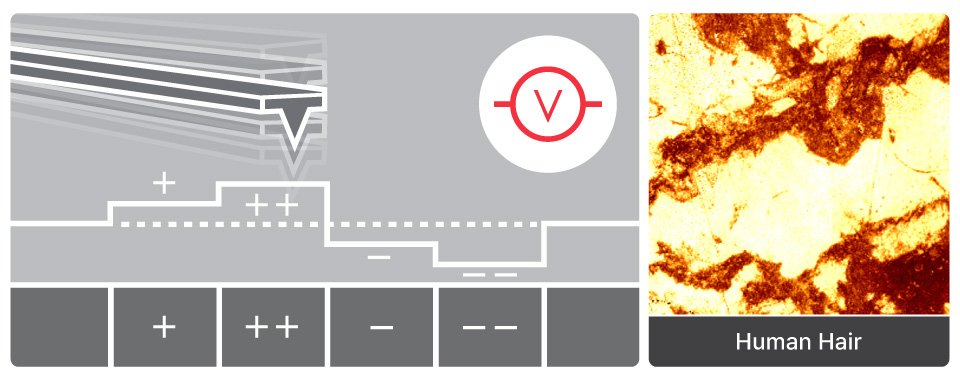
KPFM measures local surface potential and work function by actively nullifying electrostatic forces between a conductive AFM tip and the sample, enabling quantitative nanoscale mapping of electronic properties with high sensitivity and spatial resolution.
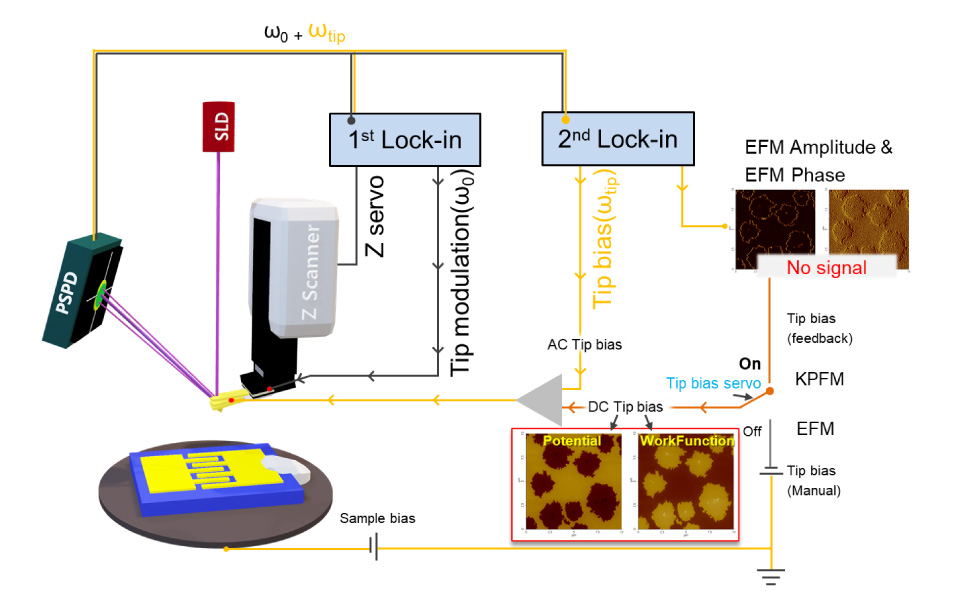
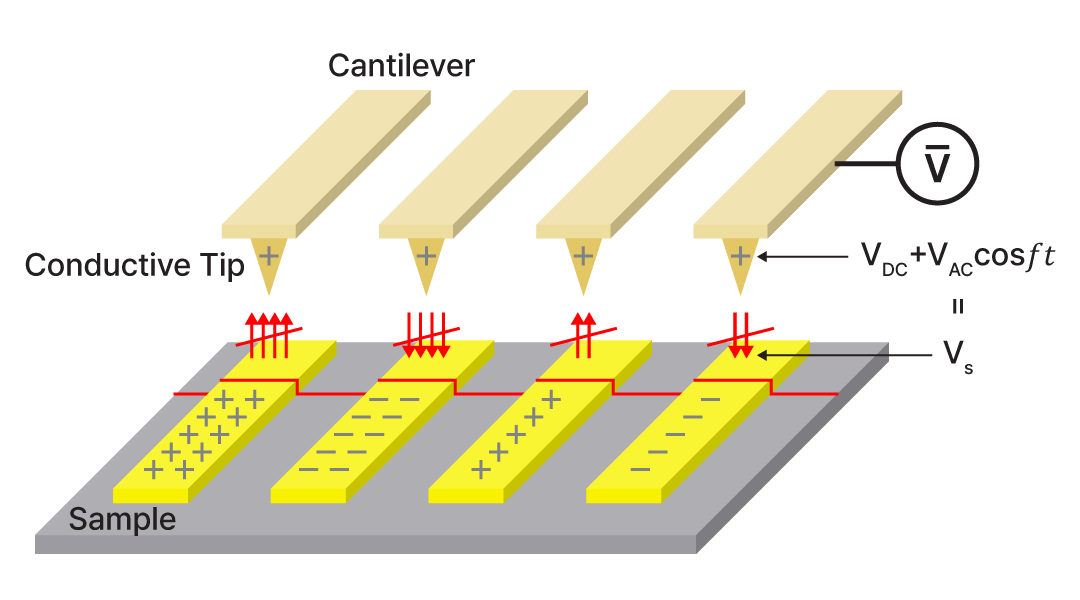
KPFM operates by applying a combination of AC and DC voltages between a conductive AFM tip and the sample during scanning. The cantilever oscillates above the surface, and the amplitude of electrostatic forces between the tip and sample is monitored. By continuously adjusting the applied DC bias to nullify the electrostatic force at each point, KPFM maps the contact potential difference across the surface with high sensitivity. This process effectively separates true surface potential signals from topographical or capacitive artifacts. As a result, KPFM provides detailed spatial maps of surface work function and electronic properties, enabling direct visualization of charge injection, electronic inhomogeneity, junctions, and interfaces in semiconductors, photovoltaics, and other functional materials.
Reasons to Use This Mode
Since KPFM is an advanced option of EFM, it uses the same equation of EFM.
Expanding this gives:
  • A static DC term
  • An AC term at 𝑓ₜᵢₚ (mainly used for EFM imaging)
  • A higher harmonic term at 2𝑓ₜᵢₚ
The amplitude at 𝑓ₜᵢₚ reflects the strength of surface charges, and the phase indicates their sign.

Since the amplitude of the cantilever oscillation at 𝑓ₜᵢₚ directly relates to the electrostatic force, the additional electric feedback in KPFM readjusts the DC bias to nullify this oscillation at each measurement point: for VDC=VCPD, the oscillation amplitude at 𝑓ₜᵢₚ becomes zero. The variation of the DC bias at each pixel is recorded and used to quantitatively image the surface potential distribution.
The work function is a fundamental property of a material, representing the minimum energy required to remove an electron from the surface to the vacuum level. Accurate determination of the sample work function is essential for understanding its electronic properties.

To accurately determine the sample work function (∅ₛ) from the measured surface potential (VCPD), the work function of the probe tip (∅ₜ) must be compensated. This correction is performed via software by adjusting the tip’s work function offset.

Tip calibration is carried out by measuring reference samples with well-established work functions, such as Au or HOPG.

After the tip work function compensation, the precise work function (∅ₛ) of the sample can be reliably measured.
  • ∅ₛ : Work function of Sample
  • ∅ₜ : Work function of AFM tip
  • 𝑉CPD : Measured potential by KPFM
Applications and Use Cases
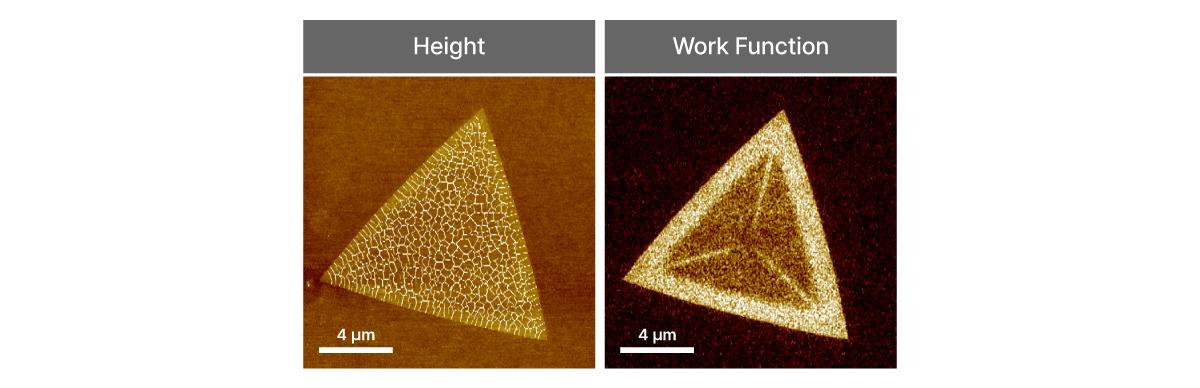
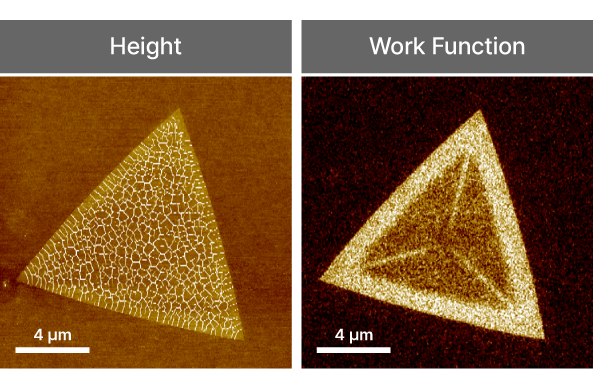
Images show the AFM height and work function images of a CVD grown WS₂ flake. In the height image, clear grain boundaries are observed across the flake surface, indicating polycrystalline structure. However, the overall triangular shape and uniform thickness are well maintained. In contrast, the work function map distinctly reveals internal domain structures, highlighting variations in the local work function. These contrast differences are attributed to different crystallographic orientations or charge distributions within the triangular flake. The combined analysis demonstrates how surface potential(or work function) mapping can uncover subtle electronic properties that are not apparent in conventional height images alone.
  • Sample: WS₂
  • System: NX10
  • Scan Size: 17 μm × 17 μm