Electrostatic Force Microscopy
EFM
High-resolution mapping of surface electrostatic forces and potential variations by detecting long-range interactions between AFM tip and the sample surface
What is EFM (Electrostatic Force Microscopy)
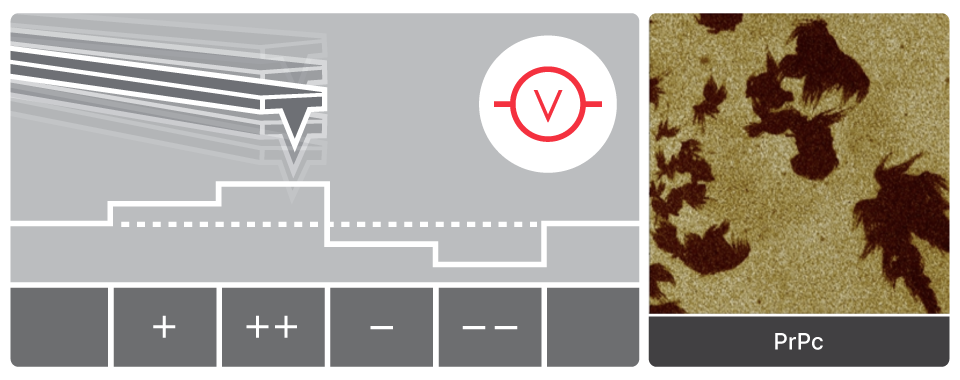
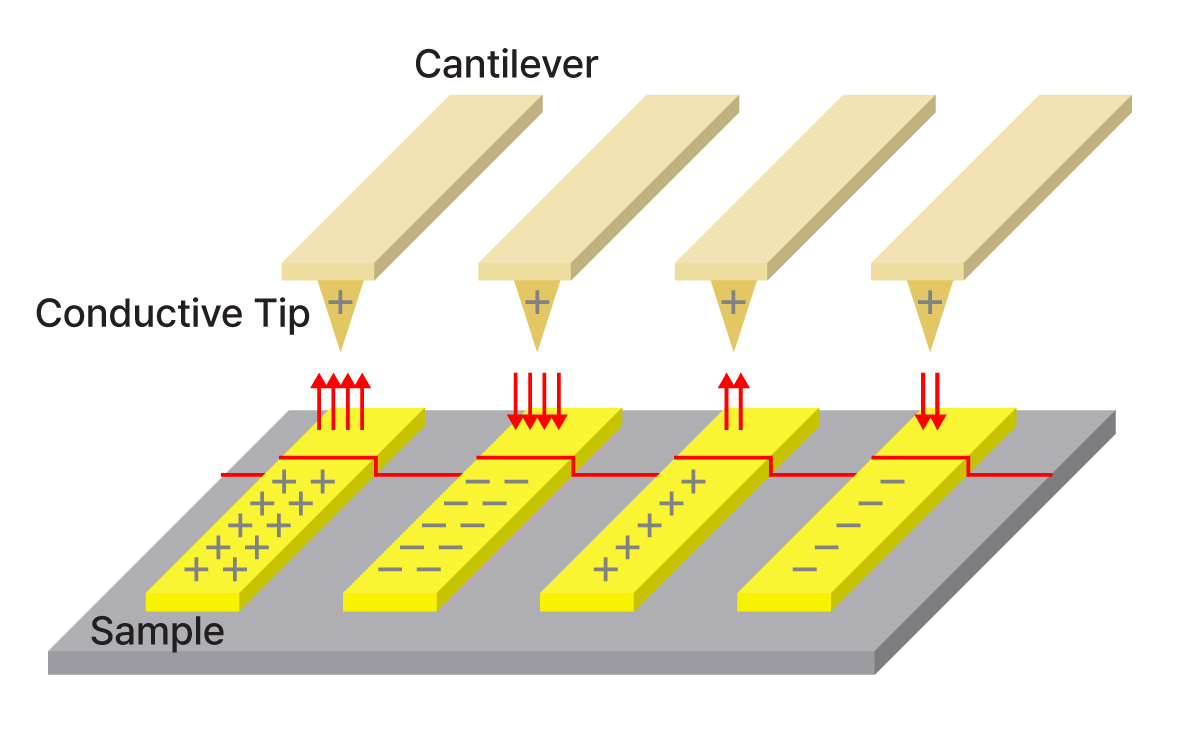
EFM measures the electrical properties of a sample surface by detecting the electrostatic interactions between a conductive, voltage-biased AFM tip and the surface, without making physical contact.
In EFM, during the scan of the sample surface, the presence of electrostatic forces leads to a change in the oscillation amplitude and phase in the vertical deflection signal. Therefore, the resulting EFM amplitude and phase images contain information about electrical properties including the surface potential and/or the charge distribution on the sample surface. The AFM tip scans above different regions of the sample, each with distinct distributions of electrical charge. The biased tip interacts with the local electric fields generated by these surface charges, leading to changes in the amplitude and phase of the cantilever’s oscillation. During scanning, these shifts are recorded, resulting in EFM amplitude and phase images that reflect spatial variations in surface potential and charge concentration.

This non-contact measurement approach effectively separates electrical information from topographical effects, making EFM useful for mapping charge domains, evaluating dielectric properties, and investigating electronic phenomena in materials such as semiconductors, polymers, and nanostructures.
Reasons to Use This Mode
Park Systems’ EFM enables simultaneous acquisition of topography and EFM signals in a single pass, without sensitivity loss.

The tip oscillates at its resonance frequency (ω₀) for non-contact topography imaging, while an additional AC bias (ωₜᵢₚ) and DC bias are applied to probe electrostatic interactions. The second lock-in amplifier applies the AC voltage and separates the EFM signal at ωₜᵢₚ from the topography signal at ω₀. This decoupling allows clear measurement of surface charge properties without interference.

The tip-sample system behaves as a capacitor, with an electrostatic force:
Expanding this gives:
  • A static DC term
  • An AC term at ωₜᵢₚ (mainly used for EFM imaging)
  • A higher harmonic term at 2ωₜᵢₚ
The amplitude at ωₜᵢₚ reflects the strength of surface charges, and the phase indicates their sign.
Applications and Use Cases
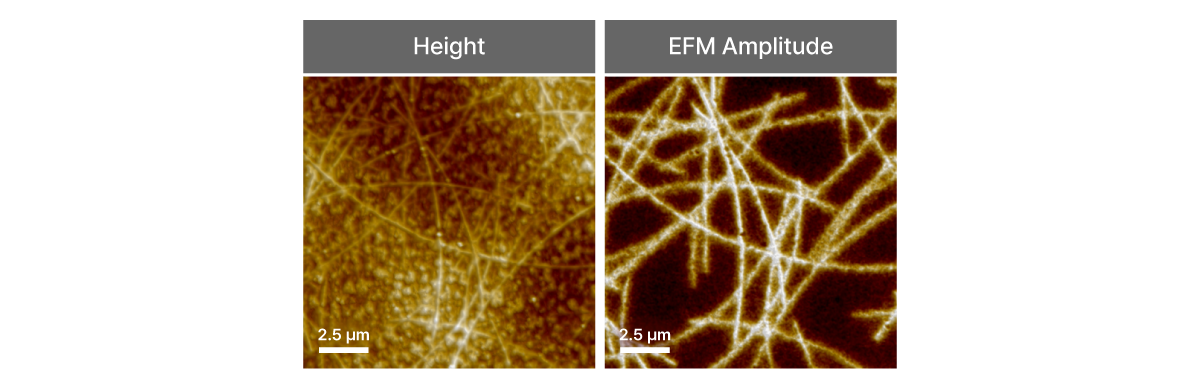
The images demonstrate the unique capability of EFM to differentiate structures based on surface electrical properties, even when topographical contrast is limited. In this example, AFM height and EFM amplitude images were obtained from PET-coated nanowires over a 15 μm × 15 μm area. Due to the thick PET coating, most nanowires are indistinguishable or only faintly visible in the height image. However, when a sample bias is applied to the bottom electrode, nanowires exhibit significantly higher surface charging compared to the surrounding PET layer, resulting in strong, clear contrast in the EFM amplitude image. This allows EFM to selectively and sensitively visualize embedded or coated nanostructures that are otherwise concealed in conventional topography scans, highlighting its value for advanced materials characterization and charge distribution analysis in functional nanodevices.
  • Sample: PET Coated Nanowires
  • System: NX10
  • Scan Size: 15 μm × 15 μm