AFM Augmented Sample Fabrication for Next-Generation Layered Materials Devices




Park Systems UK Ltd, Nottingham, United Kingdom


AFM is a go-to technique for measurements of the nanoscale surface morphology and functional properties of layered materials due to its excellent spatial resolution and surface specificity. One aspect of AFM that has increasingly been exploited of late in layered materials research is using the probe to post-process and manipulate samples deterministically. Examples of where manipulation has been done include anodic oxidation to cut flakes of layered materials, applied bias to pole ferroelectric layers, the application of force to control the orientation between and strain across flakes, removal of trapped interfacial contamination and the formation of single photon emitters by indentation.
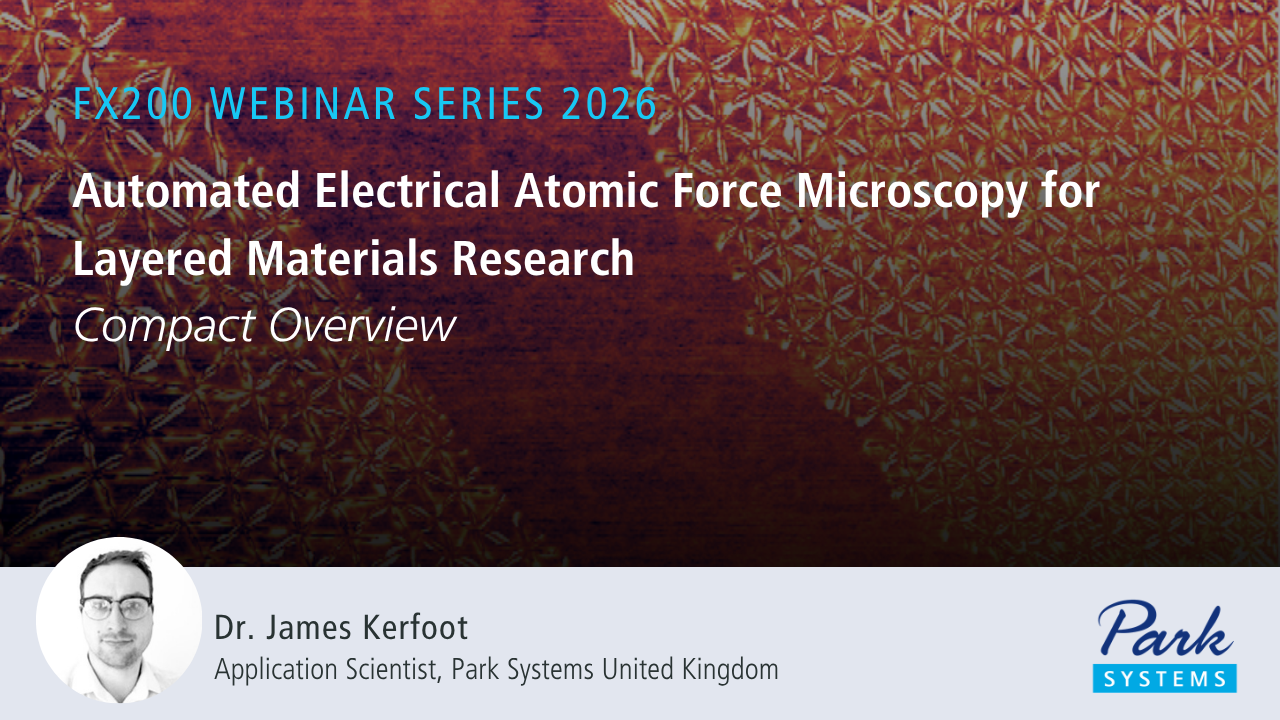
In this webinar, we will showcase the ability of our FX series AFMs to manipulate layered samples and facilitate systematic experiments based on twist angle, layer sliding and strain in layered materials. Our FX series AFMs have unique features that are ideal for this task, namely excellent resolution and the ability to switch probes and modes automatically, with no need to touch the instrument. We will give a live two-part demonstration where we first show the cutting of graphene flakes by anodic oxidation and use our probe switching functionality to switch to a new probe to generate high resolution images of the results of cutting. We will then demonstrate the ability of our systems to seamlessly switch modes to measure moiré patterns in a marginally twisted MoS2 bilayer via lateral force microscopy and conductive AFM, prepared using high temperature AFM cleaning.
We will demonstrate that the combination of excellent performance across the full range of AFM modes with advanced automation enables the formation and characterisation of layered materials heterostructures with controlled twist angle, improved cleanliness and lateral patterning. Our FX series AFMs make it much easier for researchers in the layered materials field to prepare samples and verify what they have made, enabling much more sophisticated experiments than traditional AFMs!